-
화면크기
-


- 재단소개
- 알림
- 자료
- 참여
- 정보공개
- 홈페이지이용안내
- 작성일 2008.12.05
- 조회수 4306
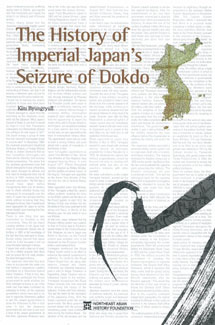 |
The History of Imperial Japan's Seizure of Dokdo |
|
|
o 저자 |
Byungryull Kim |
|
|
o 사양 |
신국판 | 199쪽 |
|
|
o 분류 |
외국어도서 |
|
|
o 정가 |
비매품 |
|
|
o 발간일 |
2008년 11월 28일 |
|
|
o ISBN |
978-89-6187-066-5 |
|
|
저자 |
||
|
Byung Ryull Kim
Byung Ryull Kim is an international law scholar on Dokdo with extensive research and policy advisory experience. A graduate of Korea Military Academy, he earned his Ph.D. in Law from Korea University, specializing in international law. He became a professor at Korea National Defense University in 1989, where he has been teaching international law. He authored sixteen scholarly works on Dokdo, some of which were published in Japanese or English. Kim served as the head of the Dokdo Response Team at the Blue House and as the inaugural director of he Dokdo Research Institute at Northeast Asian History Foundation.
|
||
|
도서 소개 |
||
|
The Japanese claim that they took steps to incorporate the islets into their territory in response to a petition submitted by a fisherman named Nakai Yosaburo. If that is true, they would have contacted the Korea government to verify whether the islets belonged to Korea or not. If the islets had then been confirmed as belonging to Korea, all the Japanese government would have had to do was to reject the fisherman's petition or ask the Joseon government to allow the fisherman to fish in that area. In fact, the Japanese government did not have to ask such a favor of the Joseon government. At that time, Japanese fishermen were free to fish in the sea near the Korea coast under the Joseon (Korea) - Japan Trade Regulations signed in 1883 and the Joseon(Korea) - Japan Fishing Regulations signed in 1889. All these circumstances make it possible to guess that Japan took such a step for military reasons, without taking the trouble to check whether the islets belonged to Korea. At that time, Russia was one of the most powerful countries in the world.In making preparations for a war against such a powerful country, Japan musthave known the strategic value of Dokdo in the East Sea. Thus, it would be meaningful to check the process by which Japan incorporated the islets into its territory from such a perspective.
|
||
|
차례 |
||
|
• Foreword |
||